
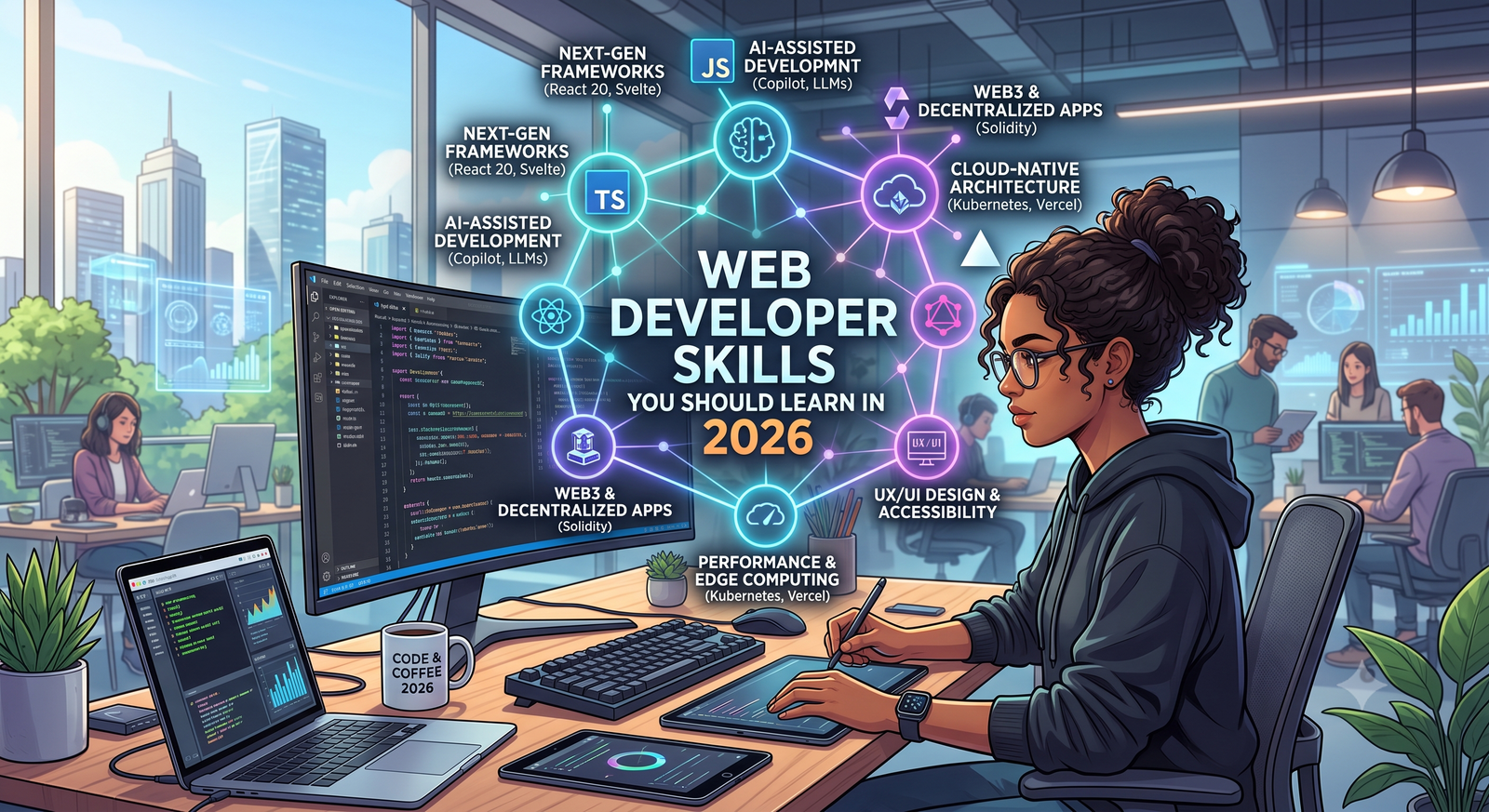
Web development has changed considerably over the last few years. The tools developers use to write code, build interfaces, manage infrastructure, and work with data are becoming more sophisticated, but the fundamentals of good development remain important.
For someone learning web development in 2026, the challenge is not finding things to learn. There are almost too many options.
Should you learn JavaScript or TypeScript? React or another frontend framework? Should you focus on backend development, cloud platforms, databases, or AI-assisted development? And how much should you know about security, testing, or DevOps?
The answer depends on your career direction, but some web developer skills in 2026 are useful across almost every modern web development role.
The most valuable developers are not necessarily the ones who know the largest number of frameworks. They are developers who understand how the web works, can solve problems, write maintainable code, work with modern tools, and continue learning as technologies change.
This guide covers the technical and practical web development skills worth developing in 2026, whether you’re starting from scratch or looking to strengthen an existing skill set.
1. Strong HTML and CSS Fundamentals
Modern frontend frameworks get a lot of attention, but HTML and CSS remain fundamental web technologies.
A developer who understands the underlying platform can build better interfaces and troubleshoot problems more effectively.
HTML Skills
You should understand:
- Semantic HTML
- Forms
- Links and navigation
- Tables
- Images and media
- Document structure
- Accessibility-related attributes
- Metadata
Semantic HTML is particularly important because elements communicate meaning to browsers, assistive technologies, and search engines.
For example, using:
<nav>
  <a href="/about">About</a>
</nav>
is more meaningful than creating a generic div and attempting to reproduce navigation behavior manually.
CSS Skills
You should also be comfortable with:
- Flexbox
- CSS Grid
- Responsive design
- Media queries
- Positioning
- Typography
- CSS variables
- Transitions and animations
- Modern layout techniques
You do not need to memorize every CSS property. You need to understand how CSS behaves well enough to create responsive interfaces and diagnose layout problems.
These fundamentals become even more valuable when working with frontend frameworks.
2. JavaScript and TypeScript
JavaScript remains one of the central programming languages of the web.
Understanding JavaScript should be a priority for anyone pursuing frontend development and is also valuable for full-stack developers.
Important JavaScript concepts include:
- Variables and data types
- Functions
- Objects and arrays
- Modules
- DOM manipulation
- Events
- Promises
- Async/await
- Error handling
- Closures
- Scope
- APIs
- Modern JavaScript syntax
You should understand not only how to write JavaScript but also how asynchronous code works.
For example:
async function getUser() {
  const response = await fetch("/api/user");
  return response.json();
}
Understanding what happens during the request, how promises work, and how errors should be handled is more useful than simply memorizing the syntax.
Why Learn TypeScript?
TypeScript adds static typing to JavaScript and is widely used in modern application development.
You should understand:
- Types
- Interfaces
- Type aliases
- Generics
- Union and intersection types
- Type narrowing
- Function typing
- Configuration
TypeScript can make larger codebases easier to understand and maintain, particularly when multiple developers are working on the same application.
For developers in 2026, being comfortable reading and writing TypeScript is a useful addition to core JavaScript knowledge.
3. Frontend Framework Skills
Modern applications frequently use frontend frameworks or libraries to manage complex interfaces.
Popular ecosystems include React, Vue, Angular, Svelte, and frameworks built around them.
The specific framework you learn matters less than understanding the concepts behind modern frontend development.
Important frontend skills include:
- Component-based development
- State management
- Routing
- Forms
- Data fetching
- Error handling
- Reusable components
- Performance optimization
- Accessibility
- Testing
For example, instead of building every page independently, a component-based application may create reusable pieces:
Application
├── Header
├── Navigation
├── ProductCard
├── SearchBox
├── ShoppingCart
└── Footer
This approach makes complex interfaces easier to organize and maintain.
If you already know one major framework, learning several others at a superficial level may be less useful than becoming highly competent with the concepts shared across them.
4. Responsive and Accessible Web Design
A website needs to work across different screen sizes and for people with different accessibility needs.
Responsive development means creating interfaces that adapt to desktops, tablets, phones, and other screen sizes.
You should understand:
- Mobile-first development
- Flexible layouts
- Responsive images
- Breakpoints
- Touch-friendly interfaces
- Flexible typography
Accessibility should be part of the same process.
Learn about:
- Keyboard navigation
- Focus management
- Semantic HTML
- Screen readers
- Color contrast
- Form labels
- Alternative text
- Accessible interactive components
Accessibility is not simply a final checklist. It affects how interfaces should be designed and implemented from the beginning.
5. API Development and Integration
Modern web applications rarely operate in isolation.
Frontend applications communicate with backend systems, payment providers, authentication platforms, analytics services, databases, and other applications.
That makes API knowledge an important part of modern developer skills.
You should understand:
- HTTP
- Request and response methods
- Status codes
- Headers
- JSON
- REST APIs
- Authentication
- Authorization
- API errors
- Rate limiting
- API documentation
A basic request might look like:
const response = await fetch("/api/products");

if (!response.ok) {
  throw new Error("Failed to load products");
}

const products = await response.json();
Understanding what happens between the browser and server helps developers work across frontend and backend boundaries.
6. Backend Development
Even if you plan to specialize in frontend development, basic backend knowledge can make you a more effective developer.
Important backend skills include:
- Server-side programming
- API development
- Authentication
- Authorization
- Database interaction
- Validation
- Error handling
- File handling
- Background jobs
- Caching
Common backend ecosystems include Node.js, Python, PHP, Java, C#, Go, and others.
You do not need to master every backend language.
Instead, choose one and learn how backend applications actually work.
For example:
Browser
   ↓
HTTP Request
   ↓
Backend
   ↓
Business Logic
   ↓
Database
   ↓
HTTP Response
   ↓
Browser
Understanding this flow is more important than simply knowing a particular framework.
7. Database Skills
Almost every meaningful web application needs to store and retrieve data.
That makes database knowledge one of the most useful programming skills for web developers.
You should understand:
- Tables and records
- Primary keys
- Foreign keys
- Relationships
- Indexes
- Queries
- Transactions
- Data validation
- Database migrations
SQL is particularly valuable.
For example:
SELECT id, name, email
FROM users
WHERE active = true;
Developers should understand what the query does and why indexes can affect its performance.
SQL and NoSQL
It is useful to understand the difference between relational and non-relational databases.
Relational databases such as PostgreSQL and MySQL are widely used for structured data and relationships.
NoSQL databases can be useful for certain data models and access patterns.
The goal is not to memorize every database product. Learn the principles first.
8. Git and Version Control
Git is one of the most practical skills a developer can learn.
It allows developers to track changes, collaborate with others, create branches, review code, and recover from mistakes.
You should be comfortable with:
git clone
git status
git add
git commit
git pull
git push
git branch
git merge
You should also understand concepts such as:
- Branches
- Pull requests
- Merge conflicts
- Commit history
- Code reviews
- Reverting changes
Version control is not just about saving copies of your code.
It is part of how modern development teams collaborate.
9. Testing and Debugging
Writing code is only one part of development.
You also need to determine whether the code behaves correctly.
Testing skills should include an understanding of:
- Unit testing
- Integration testing
- End-to-end testing
- Test organization
- Mocking
- Test coverage
- Regression testing
You do not necessarily need to write hundreds of tests for every small project.
You should understand what needs testing and where automated testing provides the most value.
Debugging Skills Matter Even More
Developers spend significant time investigating problems.
Learn how to:
- Read error messages
- Use browser developer tools
- Inspect network requests
- Examine logs
- Reproduce bugs
- Isolate problems
- Form and test hypotheses
A developer who can systematically debug an unfamiliar problem is valuable regardless of the programming language being used.
10. Web Performance Optimization
Users expect websites and applications to respond quickly.
Performance should therefore be part of your web development skills, not an afterthought.
Learn about:
- Image optimization
- Lazy loading
- Caching
- Code splitting
- Compression
- Browser caching
- Network requests
- JavaScript performance
- Rendering performance
- Core Web Vitals
For example, loading a large image when a much smaller image would work can unnecessarily increase page weight.
Likewise, shipping large JavaScript bundles can delay useful interaction.
Performance optimization starts with understanding where the time and resources are actually being spent.
11. Web Security
Security knowledge is essential for modern web development.
You do not need to become a cybersecurity specialist, but you should understand common web vulnerabilities and how to avoid them.
Important areas include:
- Cross-site scripting (XSS)
- SQL injection
- Cross-site request forgery (CSRF)
- Authentication security
- Authorization
- Password hashing
- Secure cookies
- HTTPS
- Input validation
- Dependency security
- Secrets management
One important principle is to never trust client-provided input.
For example, if a user submits:
price = 1
the backend should not simply assume the value is legitimate.
Important business rules and security checks should be enforced on the server.
Security is much easier to build into an application from the beginning than to retrofit after vulnerabilities are discovered.
12. Cloud and Deployment Skills
You do not need to become a cloud infrastructure expert to be a good web developer.
However, understanding how applications move from your computer to production is increasingly useful.
Learn the basics of:
- Hosting
- DNS
- Domains
- Environment variables
- Containers
- CI/CD
- Logs
- Monitoring
- Backups
- Cloud services
You should understand a basic deployment pipeline:
Developer
   ↓
Git Repository
   ↓
Build / Test
   ↓
Deployment
   ↓
Production
   ↓
Monitoring
This knowledge helps you understand what happens after the code leaves your development machine.
13. Command-Line and Linux Skills
The command line remains an important tool for developers.
You should be comfortable navigating files, running development commands, inspecting processes, and working with servers.
Useful concepts include:
cd
ls
pwd
mkdir
rm
cp
mv
grep
curl
You should also understand basic Linux concepts such as:
- Files and directories
- Permissions
- Processes
- Environment variables
- Package management
- Logs
- SSH
You do not need to become a system administrator.
Basic command-line confidence can simply make development work faster and less frustrating.
14. AI-Assisted Development
AI-assisted development has become an important part of modern programming workflows.
Developers can use AI-based tools to help with tasks such as:
- Explaining unfamiliar code
- Generating boilerplate
- Writing test cases
- Refactoring code
- Exploring implementation approaches
- Debugging errors
- Creating documentation
- Learning unfamiliar APIs
But using these tools effectively requires strong fundamentals.
If you cannot evaluate generated code, you may introduce bugs, security vulnerabilities, or unnecessary complexity without realizing it.
That makes a new skill particularly important:
Code evaluation.
You should be able to ask:
- Is this code correct?
- Is it secure?
- Is it efficient?
- Is it maintainable?
- Does it actually solve the problem?
- What assumptions does it make?
AI-assisted development is most useful when the developer remains responsible for understanding and validating the result.
15. Problem-Solving and System Thinking
Technical knowledge is important, but problem-solving remains one of the most valuable developer skills.
A developer may encounter a requirement such as:
“Users are reporting that the checkout page is slow.”
The solution is not immediately “add caching.”
First, investigate.
Is the problem caused by:
- Frontend JavaScript?
- A slow API?
- Database queries?
- Third-party services?
- Network latency?
- Large images?
- Server capacity?
System thinking means understanding how different components interact.
Browser
  ↓
Frontend
  ↓
API
  ↓
Backend
  ↓
Database
  ↓
External Services
A problem in one layer can sometimes be caused by another.
Learning to trace the entire system is one of the skills that separates basic coding ability from professional development.
16. Communication and Collaboration
Not all important developer skills are technical.
Most professional developers work with other people.
You may need to communicate with:
- Designers
- Product managers
- QA engineers
- Backend developers
- Frontend developers
- Business stakeholders
- Customers
- Infrastructure teams
Useful communication skills include:
- Explaining technical decisions clearly
- Writing useful documentation
- Asking precise questions
- Giving constructive code reviews
- Discussing trade-offs
- Reporting bugs clearly
- Estimating work realistically
Being technically capable but unable to explain decisions can make collaborative development much harder.
17. Learn to Read Documentation
One underrated skill is knowing how to find answers independently.
Developers constantly encounter unfamiliar tools, APIs, libraries, errors, and configuration options.
Good developers learn to use:
- Official documentation
- API references
- Source code
- Issue trackers
- Technical specifications
- Reliable community discussions
Instead of memorizing everything, learn how to locate authoritative information and determine whether it applies to your situation.
This becomes especially important as development tools continue to change.
18. Architecture and Technical Decision-Making
As you progress, your responsibilities will move beyond writing individual functions.
You will start making decisions about how systems should be structured.
This means learning concepts such as:
- Separation of concerns
- Modularity
- Dependency management
- Caching
- Queues
- Scalability
- Availability
- Data consistency
- Service boundaries
- API design
You do not need to design a massive distributed system as a beginner.
Start with simple questions:
Where should this logic live?
Should this component be reusable?
Should this operation happen synchronously?
What happens if the external service fails?
These questions develop architectural thinking over time.
Web Developer Skills 2026: What Should You Learn First?
The long list of technologies can be overwhelming, especially for beginners.
You do not need to learn everything at once.
A practical learning sequence could look like this:
HTML + CSS
      ↓
JavaScript
      ↓
Git
      ↓
Frontend Framework
      ↓
APIs
      ↓
Backend Basics
      ↓
Database
      ↓
Testing
      ↓
Security
      ↓
Deployment
      ↓
Architecture
Once you have the fundamentals, you can specialize.
If You Want to Become a Frontend Developer
Focus on:
- HTML
- CSS
- JavaScript
- TypeScript
- A frontend framework
- Responsive design
- Accessibility
- Browser APIs
- Performance
- Testing
If You Want to Become a Backend Developer
Focus on:
- One backend language
- API development
- Databases
- Authentication
- Security
- Testing
- Caching
- Deployment
- System design
If You Want to Become a Full-Stack Developer
Develop a working understanding of both sides.
Important full stack developer skills include:
- HTML and CSS
- JavaScript/TypeScript
- Frontend frameworks
- Backend development
- APIs
- Databases
- Git
- Testing
- Security
- Deployment
- Basic architecture
You do not have to become an expert in every area immediately.
Full-stack development is about understanding how the pieces fit together and being able to work across the application.
The Skills That Stay Valuable
Technology changes quickly.
Frameworks change. Libraries are replaced. Development tools evolve. New AI-assisted workflows appear.
That makes it tempting to constantly chase the newest technology.
A better approach is to build skills that survive technological changes.
These include:
- Understanding web fundamentals
- Problem-solving
- Debugging
- Reading documentation
- Writing maintainable code
- Understanding APIs
- Database fundamentals
- Security awareness
- Testing
- Communication
- System thinking
If you understand these concepts, learning a new framework becomes much easier.
For example, a developer who understands components, state, routing, APIs, and asynchronous programming can generally adapt to a new frontend framework more easily than someone who has only memorized the syntax of one framework.
Final Thoughts
The most useful web developer skills in 2026 are not simply a collection of the newest tools.
They are a combination of strong fundamentals, modern development practices, practical technical knowledge, and the ability to learn continuously.
Start with HTML, CSS, JavaScript, Git, and web fundamentals. Then build deeper knowledge in frontend or backend development. Add databases, APIs, testing, security, deployment, performance, and architecture as your experience grows.
AI-assisted development is also becoming an increasingly relevant part of the workflow, but it does not replace the need to understand the code you are building.
Most importantly, do not measure your progress by the number of technologies you can list on a résumé.
Measure it by the problems you can solve.
A developer who can understand a requirement, design a sensible solution, write reliable code, investigate problems, communicate with a team, and maintain the resulting application has a foundation that remains valuable even as the technology landscape changes.
That is the real goal of learning modern web development in 2026.