
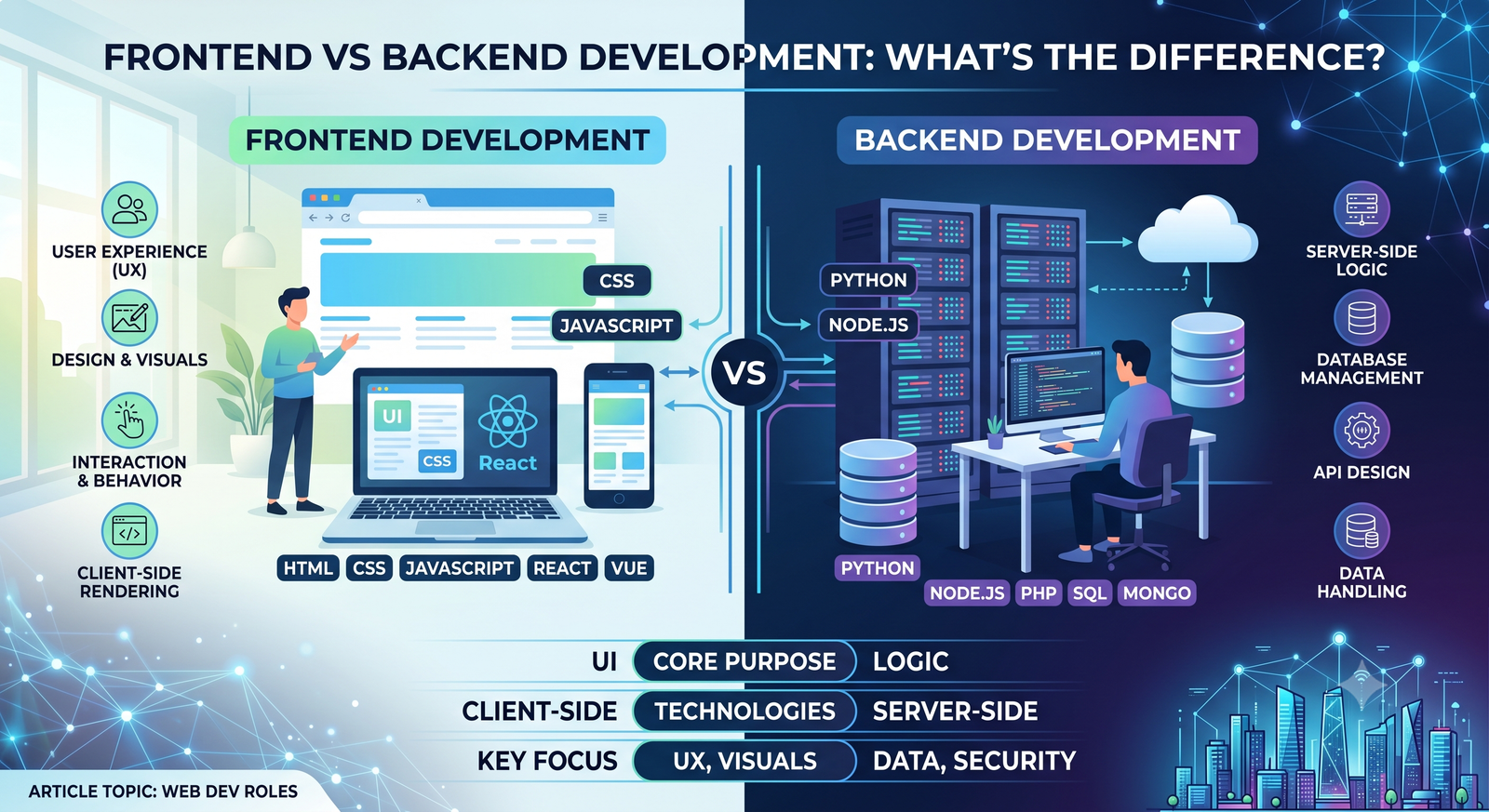
When you open a website, you see a page, click buttons, fill out forms, browse menus, and interact with content.
But what you see is only one part of the system.
Behind that interface, servers process requests, databases store information, authentication systems protect accounts, APIs move data between applications, and business logic determines what should happen when you perform an action.
This is where the distinction between frontend vs backend development becomes important.
Frontend development focuses primarily on what users interact with in a browser or application interface. Backend development focuses on the server-side systems that process data, implement business rules, communicate with databases, and support the frontend.
Neither side exists in isolation.
A modern web application might look like this:
User
  ↓
Frontend
  ↓
API
  ↓
Backend
  ↓
Database
Understanding how these pieces fit together is useful whether you’re thinking about becoming a frontend developer, a backend developer, or eventually working in full stack development.
Let’s break down the difference.
What Is Frontend Development?
Frontend development is the part of web development focused on the interface that users see and interact with.
When you visit an online store and see:
- Product images
- Navigation menus
- Search boxes
- Buttons
- Shopping carts
- Forms
- Animations
- Product filters
the frontend is responsible for much of that experience.
Frontend code typically runs in the user’s browser.
The core technologies are:
- HTML
- CSS
- JavaScript
Modern applications may also use frontend frameworks and libraries such as React, Vue, Angular, or Svelte.
A Simple Example
Imagine a login page:
+--------------------------+
|       Welcome Back       |
|                          |
| Email:    [___________]  |
| Password: [___________]  |
|                          |
|       [ Log In ]         |
+--------------------------+
The frontend determines how this form looks, how it responds when someone types, how errors are displayed, and how the interface communicates with the backend.
When the user clicks “Log In,” the frontend might send a request:
POST /api/login
The backend then processes that request.
What Does a Frontend Developer Do?
A frontend developer turns designs and requirements into interactive web interfaces.
Their work can include:
- Building page layouts
- Writing HTML
- Styling interfaces with CSS
- Writing JavaScript
- Creating reusable components
- Connecting interfaces to APIs
- Handling forms
- Implementing responsive designs
- Improving browser performance
- Supporting accessibility
- Testing interfaces
- Fixing browser-specific issues
A frontend developer isn’t simply someone who “makes websites look good.”
Modern frontend development can involve substantial programming.
A complex web application might contain:
Dashboard
├── Navigation
├── User settings
├── Charts
├── Data tables
├── Notifications
├── Search
├── Filters
└── Real-time updates
The frontend developer needs to manage how all these elements behave and interact.
What Technologies Do Frontend Developers Use?
The foundation remains HTML, CSS, and JavaScript.
HTML
HTML defines the structure of a page.
<h1>Products</h1>
<p>Browse our latest products.</p>
CSS
CSS controls presentation and layout.
.card {
  padding: 20px;
  border-radius: 8px;
}
JavaScript
JavaScript adds behavior and interactivity.
button.addEventListener("click", () => {
  console.log("Button clicked");
});
Frameworks and Libraries
Developers may then use technologies such as React, Vue, Angular, or Svelte to build more sophisticated interfaces.
Other tools may handle:
- Routing
- State management
- API requests
- Testing
- Build processes
- Styling
- Component libraries
The exact technology stack varies from project to project.
What Is Backend Development?
Backend development focuses on the server-side part of an application.
The backend is responsible for processing requests and performing operations that shouldn’t happen entirely in the browser.
For example, when you log into a website, the frontend collects your credentials.
The backend might then:
- Receive the login request.
- Validate the input.
- Find the account in the database.
- Verify the password.
- Create an authenticated session or token.
- Return a response.
The user might only see:
Login successful
But several backend operations may have happened behind the scenes.
What Does a Backend Developer Do?
A backend developer works with the server-side systems that power applications.
Their responsibilities can include:
- Building APIs
- Writing server-side logic
- Working with databases
- Implementing authentication
- Managing permissions
- Processing payments
- Integrating external services
- Validating data
- Handling errors
- Optimizing database queries
- Monitoring server performance
- Designing backend architecture
Backend development can involve many different technologies.
Common programming languages include:
- JavaScript/TypeScript
- Python
- PHP
- Java
- C#
- Ruby
- Go
- Kotlin
- Rust
The best language depends on the project and organization.
What Technologies Do Backend Developers Use?
A backend stack often contains several layers.
For example:
Frontend
   ↓
API
   ↓
Backend Application
   ↓
Database
A backend developer might use Node.js with TypeScript, a framework such as Express or NestJS, and PostgreSQL.
Another project might use PHP with Laravel and MySQL.
Another could use Python with Django and PostgreSQL.
There is no single backend technology stack.
Frontend vs Backend Development: The Core Difference
The simplest distinction is:
Frontend development focuses on the user-facing interface. Backend development focuses on the server-side systems that support that interface.
Consider an online shopping application.
Frontend
The frontend displays:
Wireless Headphones
$79.99

[ Add to Cart ]
When the user clicks the button, the frontend sends a request.
Backend
The backend receives the request and may:
- Verify the product exists.
- Check inventory.
- Confirm the user’s account.
- Create a cart record.
- Update the database.
- Return the updated cart.
The frontend then displays the result.
This creates a continuous conversation between the two sides.
Frontend and Backend Work Together
A modern application is usually not really “frontend versus backend.”
It’s frontend and backend.
Consider a social media application.
The frontend might display:
Alex
"I just published a new article."

[Like] [Comment] [Share]
When someone clicks Like:
User
 ↓
Frontend
 ↓
POST /api/posts/123/like
 ↓
Backend
 ↓
Database
 ↓
Backend response
 ↓
Frontend
 ↓
Updated like count
The user sees a simple interaction.
Behind it, multiple systems may be involved.
APIs Connect Frontend and Backend
An API provides a communication layer between the frontend and backend.
For example, a frontend might request:
GET /api/products/123
The backend could return:
{
  "id": 123,
  "name": "Wireless Headphones",
  "price": 79.99,
  "inStock": true
}
The frontend takes that data and displays it.
This separation allows frontend and backend systems to evolve independently to some extent.
It also makes it possible for multiple clients to use the same backend.
For example:
             Backend API
            /     |     \
           /      |      \
      Website   Mobile   Admin App
Frontend vs Backend Languages
The two sides can use different technologies.
Frontend
Common technologies include:
HTML
CSS
JavaScript
TypeScript
React
Vue
Angular
Svelte
Backend
Common technologies include:
Node.js
Python
PHP
Java
C#
Ruby
Go
There is also overlap.
JavaScript and TypeScript can be used on both the frontend and backend.
This is one reason the JavaScript ecosystem is particularly interesting for developers who want to work across the entire application.
Databases and Backend Development
Databases are generally associated more closely with backend development.
A database stores information such as:
- Users
- Products
- Orders
- Payments
- Articles
- Messages
- Inventory
Common database technologies include:
- PostgreSQL
- MySQL
- SQLite
- Microsoft SQL Server
- MongoDB
- Redis
A backend application communicates with the database.
For example:
Frontend
   ↓
Backend API
   ↓
Database
A frontend shouldn’t normally connect directly to a production database.
The backend acts as a controlled layer between the client and the data.
Authentication: Another Backend Responsibility
Authentication is another area where frontend and backend work together.
The frontend provides the login interface.
The backend verifies the credentials.
For example:
Email + Password
       ↓
    Frontend
       ↓
   Login API
       ↓
    Backend
       ↓
   Database
       ↓
Authentication Result
       ↓
    Frontend
The backend needs to make sure that users can only access information they are authorized to access.
This is particularly important for applications containing private information, financial data, business information, or user accounts.
Frontend Performance vs Backend Performance
Performance exists on both sides.
Frontend Performance
Frontend developers may optimize:
- JavaScript bundles
- Images
- CSS
- Fonts
- Rendering
- Network requests
- Browser interactions
Backend Performance
Backend developers may optimize:
- Database queries
- API response times
- Server processing
- Caching
- Database indexes
- Background jobs
- External service calls
A slow website can therefore have many possible causes.
For example:
Slow Database
      ↓
Slow Backend
      ↓
Slow API
      ↓
Slow Frontend
      ↓
Poor User Experience
Solving performance problems often requires looking at the entire system rather than blaming either frontend or backend.
Frontend Development vs Backend Development: Skills
The two paths require overlapping but different skill sets.
Frontend Skills
A frontend developer benefits from understanding:
- HTML
- CSS
- JavaScript
- Responsive design
- Accessibility
- Browser APIs
- Frontend frameworks
- HTTP and APIs
- Performance
- Testing
- Git
They also need an understanding of how users interact with interfaces.
Backend Skills
A backend developer benefits from understanding:
- Programming fundamentals
- Server-side programming
- APIs
- Databases
- Authentication
- Authorization
- Security
- Caching
- Testing
- Deployment
- Git
- System architecture
Backend developers need to think carefully about data, reliability, security, and how different services communicate.
Which Is Easier: Frontend or Backend?
There isn’t a universal answer.
Frontend development can look easier initially because you can see the result immediately in a browser.
You write HTML and CSS and instantly see a page.
But modern frontend applications can become extremely complex.
Responsive design, accessibility, state management, browser compatibility, animations, performance, and application architecture all require significant knowledge.
Backend development may feel more abstract at first.
You might write an API and see little on the screen.
But backend systems involve their own complexity:
- Databases
- Authentication
- Security
- Concurrency
- Caching
- Distributed systems
- Error handling
- Deployment
Neither should be treated as the “easy” side of web development.
Frontend Developer vs Backend Developer: Which Role Fits You?
Think about what type of problems you enjoy solving.
You might enjoy frontend development if you like:
- Visual design
- User interfaces
- Interaction
- Animation
- Responsive layouts
- Immediate visual feedback
- Accessibility
You might enjoy backend development if you prefer:
- Data
- APIs
- Business logic
- Databases
- System architecture
- Security
- Performance
- Server-side problem solving
These are tendencies rather than strict rules.
A developer can enjoy both.
What Is Full Stack Development?
Full stack development involves working across both frontend and backend parts of an application.
A full stack developer might build:
Frontend
   ↓
API
   ↓
Backend
   ↓
Database
   ↓
Deployment
They may not be an expert in every layer.
Instead, they understand enough of the entire system to build and connect different parts.
For example, a full stack developer might:
- Create a React interface.
- Build an API using Node.js.
- Store data in PostgreSQL.
- Add authentication.
- Deploy the application.
- Monitor its performance.
This can be useful for startups, small teams, freelance projects, and product development.
However, full stack doesn’t mean you have to master every technology.
It’s more useful to understand how the pieces fit together.
Is Full Stack Development Better?
Not necessarily.
Full stack development is one career path, not a universal upgrade over specialization.
A large organization might have separate teams for:
Frontend
Backend
Database
Infrastructure
Security
QA
A smaller team might have developers responsible for multiple areas.
The right skill profile depends on the environment.
A developer who specializes deeply in frontend performance, accessibility, and application architecture can provide enormous value without being a backend specialist.
The same applies to backend engineering.
Frontend vs Backend Career Opportunities
Both areas offer a range of career paths.
Frontend Careers
You could work as a:
- Frontend developer
- UI developer
- React developer
- Angular developer
- Vue developer
- Design systems developer
- Frontend engineer
Backend Careers
You could work as a:
- Backend developer
- Backend engineer
- API developer
- Software engineer
- Platform engineer
- Database-focused developer
Broader Roles
With experience across multiple areas, you might move toward:
- Full stack developer
- Software architect
- Technical lead
- Engineering lead
Titles vary between organizations, so look at the actual responsibilities rather than the title alone.
What Should Beginners Learn First?
If you’re completely new to web development, don’t try to learn frontend and backend simultaneously.
Start with the web fundamentals.
A practical path is:
HTML
 ↓
CSS
 ↓
JavaScript
 ↓
Git
 ↓
HTTP and APIs
 ↓
Frontend framework
 ↓
Backend programming
 ↓
Database
Once you understand the basics of the frontend, learning how a backend supports it becomes easier.
You can then build small full stack projects.
A Good Beginner Project
A task manager is a useful example.
Frontend
Build an interface where users can:
- See tasks
- Add tasks
- Edit tasks
- Mark tasks complete
- Delete tasks
Backend
Create API endpoints such as:
GET    /api/tasks
POST   /api/tasks
PATCH  /api/tasks/123
DELETE /api/tasks/123
Database
Store the tasks:
id
title
completed
created_at
Now you have a complete application:
Browser
  ↓
Frontend
  ↓
REST API
  ↓
Backend
  ↓
Database
This type of project teaches the relationship between frontend and backend much better than studying the two areas entirely in isolation.
Common Misconceptions About Frontend and Backend
“Frontend is just design.”
Modern frontend development involves significant programming, architecture, performance optimization, testing, and accessibility work.
“Backend is only databases.”
Backend development includes APIs, business logic, authentication, integrations, background processing, security, and much more.
“Full stack developers know everything.”
Nobody knows everything.
Full stack developers generally have broader knowledge across the application rather than complete mastery of every technology.
“You have to choose one forever.”
You don’t.
Many developers move between frontend, backend, and full stack roles during their careers.
Why Both Sides Need Security
Security isn’t only a backend concern.
Frontend developers need to understand issues such as:
- Cross-site scripting
- Unsafe DOM manipulation
- Secure handling of tokens
- Content security policies
- Third-party scripts
Backend developers need to think about:
- Authentication
- Authorization
- Input validation
- SQL injection
- API security
- Password storage
- Access control
Security is an application-wide responsibility.
A secure backend can still be undermined by unsafe frontend code, and a well-built frontend cannot compensate for an insecure backend.
How Frontend and Backend Teams Collaborate
In professional development environments, frontend and backend teams often need to agree on an API contract.
For example:
GET /api/users/42
might return:
{
  "id": 42,
  "name": "Alex",
  "email": "alex@example.com"
}
The frontend team needs to know:
- What endpoint to call
- Which parameters are required
- What the response looks like
- What errors can occur
- How authentication works
The backend team needs to understand what the frontend requires.
Clear API documentation can prevent many misunderstandings.
Frontend vs Backend Development in Modern Applications
The distinction between frontend and backend is becoming more flexible.
Modern web applications can use:
- Server-side rendering
- Static generation
- Server components
- Edge functions
- Serverless functions
- API routes
- Backend-as-a-service platforms
- Managed databases
Some code may execute on the server while still being part of a frontend-oriented framework.
This means the traditional “browser equals frontend, server equals backend” model is useful for learning but doesn’t describe every modern architecture.
The underlying concepts remain the same:
- Where does the code execute?
- Who can access the data?
- Where does business logic live?
- How is state managed?
- How do different components communicate?
Understanding these questions is more valuable than memorizing labels.
Web Development Careers: Choosing a Path
If you’re considering web development careers, don’t choose solely based on which role sounds more impressive.
Try both sides.
Build a simple interface.
Then connect it to an API.
Then create the API.
Then connect the API to a database.
Pay attention to which problems you enjoy.
If you spend hours adjusting a layout because you enjoy making the interface feel right, frontend may be worth exploring further.
If you find yourself more interested in database design, API architecture, and server-side logic, backend may be a better direction.
And if you enjoy connecting everything together, full stack development could be worth exploring.
Final Thoughts
Understanding frontend vs backend development is one of the first important concepts for anyone entering web development.
Frontend development focuses primarily on the user-facing experience. Backend development handles server-side logic, data, APIs, authentication, and other systems that power the application.
A typical application connects them like this:
User
 ↓
Frontend
 ↓
API
 ↓
Backend
 ↓
Database
Frontend developers work with technologies such as HTML, CSS, JavaScript, TypeScript, and frontend frameworks. Backend developers work with server-side languages, APIs, databases, authentication, and infrastructure.
Neither side is inherently more important.
A beautiful interface is not useful if the backend doesn’t work. A powerful backend doesn’t create a good product if the interface is confusing or inaccessible.
For beginners, start with web fundamentals and gradually explore both sides. You don’t need to decide your entire career immediately.
Learn how a browser works. Build interfaces. Learn HTTP and APIs. Create a backend. Connect a database. Build something that works from beginning to end.
Once you understand how the pieces fit together, you’ll have a much clearer idea of whether you want to specialize in frontend development, backend development, or move toward full stack development.
The most valuable skill isn’t simply knowing one side of the application. It’s understanding how the entire system works and how your work affects the people using it.