
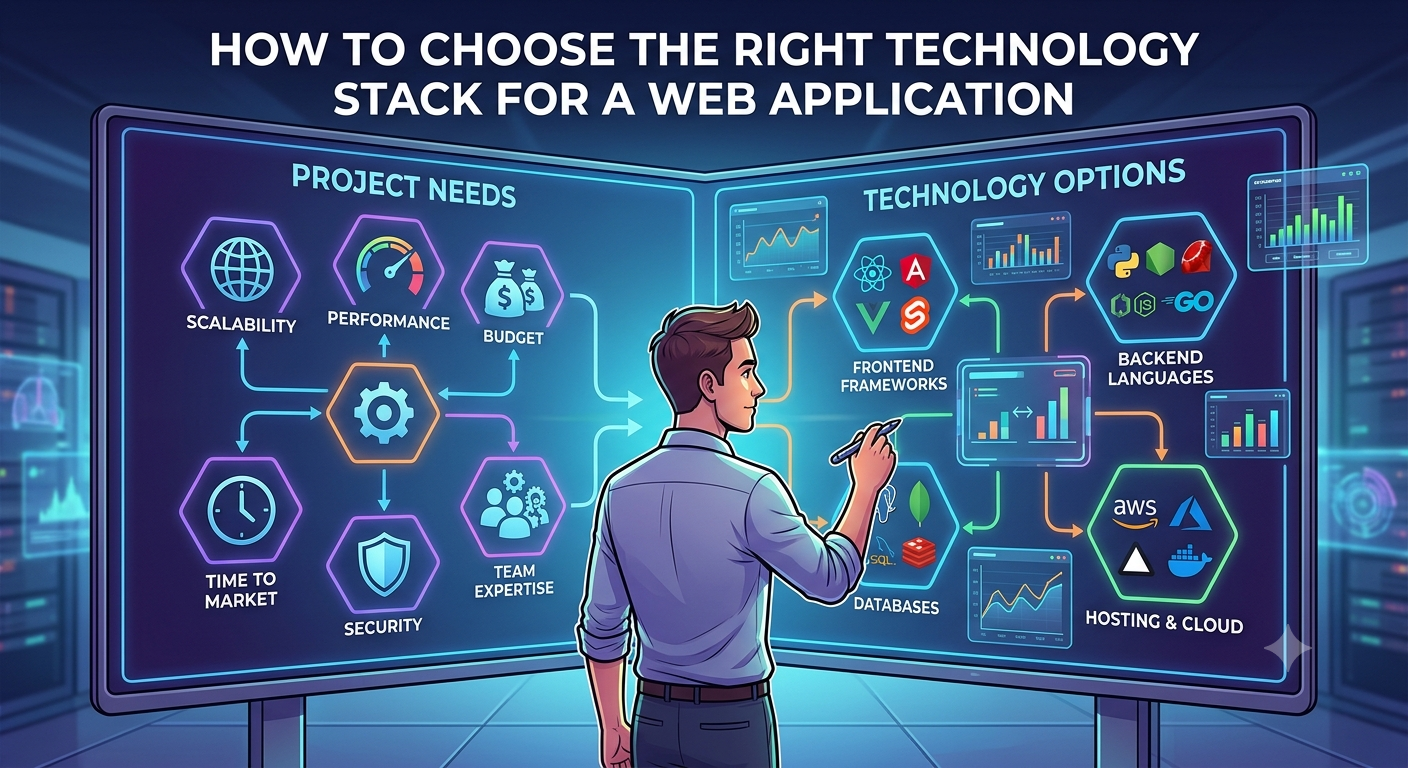
Choosing the right technology stack for a web application is one of the earliest decisions in a development project, and it can have consequences long after the first version goes live.
A tech stack affects how quickly developers can build features, how easily the application can scale, how much it costs to maintain, how secure it can be, and how easily new developers can work on it later.
The challenge is that there is no universally perfect stack.
React might be a sensible frontend choice for one project and unnecessary complexity for another. PostgreSQL may be an excellent database for one application, while a document database could make more sense for a different data model. A technology that is popular today may also become less suitable as a project changes.
That is why choosing a web development stack should start with the application itself—not with a list of fashionable technologies.
This guide explains what a technology stack includes, the factors you should consider, and how to choose frontend, backend, database, hosting, and supporting technologies for a web application.
What Is a Technology Stack?
A tech stack is the collection of technologies used to build and operate an application.
For a typical web application, the stack may include:
- Frontend technology
- Backend technology
- Database technology
- APIs
- Web server
- Hosting infrastructure
- Authentication tools
- Caching systems
- Monitoring and logging tools
- Development and deployment tools
A simplified stack might look like this:
User
  ↓
Frontend
  ↓
API / Backend
  ↓
Database
  ↓
Infrastructure
Each layer has a different responsibility.
For example, the frontend controls what users see and interact with. The backend handles application logic and data processing. The database stores information, while infrastructure provides the environment where everything runs.
The combination of these technologies forms the application’s technology stack.
Why Does Choosing the Right Stack Matter?
It is possible to build a working web application with many different combinations of technologies.
The harder question is whether the chosen stack will continue to work well as the application grows.
A poor technology decision can lead to:
- Difficult maintenance
- Slow development
- Higher infrastructure costs
- Security problems
- Scaling challenges
- Limited developer availability
- Difficult integrations
- Complicated deployments
- Frequent rewrites
On the other hand, a well-matched stack can make development more predictable and give the team a solid foundation for future growth.
This does not mean you need to predict everything that will happen five years from now.
You need to understand the application’s current requirements and make reasonable decisions about the future.
Start With the Application, Not the Technology
One of the most common mistakes in web application development is choosing technologies before defining the problem.
For example, a team might decide:
“We’re going to use React, Node.js, PostgreSQL, and Kubernetes.”
That sounds like a technology plan, but it does not explain why those technologies are appropriate.
A better starting point is:
- What does the application need to do?
- Who will use it?
- How many users are expected?
- What type of data will it manage?
- Does it require real-time functionality?
- Does it need third-party integrations?
- How important is search engine visibility?
- What security requirements exist?
- How quickly does the first version need to launch?
- What development skills does the team already have?
Technology choices should follow these answers.
Step 1: Define the Application Requirements
Before comparing programming languages and frameworks, create a clear list of functional and technical requirements.
Functional Requirements
These describe what the application needs to do.
For example:
- User registration
- Login and authentication
- Product management
- Payments
- Search
- Messaging
- File uploads
- Notifications
- Reporting
- Administrative dashboards
Non-Functional Requirements
These describe how the application needs to perform.
Examples include:
- Performance
- Scalability
- Availability
- Security
- Accessibility
- Reliability
- Maintainability
This distinction is important.
Two applications may have similar features but completely different technical requirements.
A simple internal reporting tool might serve 100 employees.
An online marketplace may serve millions of users and handle transactions continuously.
They should not necessarily use the same architecture.
Step 2: Consider the Type of Web Application
The type of product you’re building can strongly influence your technology decisions.
Content-Focused Website
A content-heavy website may prioritize:
- SEO
- Fast page delivery
- Content management
- Publishing workflows
A CMS or framework with strong server-side rendering capabilities may be appropriate.
SaaS Application
A SaaS product often needs:
- Authentication
- User accounts
- Dashboards
- Billing
- APIs
- Background processing
- Data management
The backend and database architecture become especially important.
Ecommerce Application
An ecommerce application may require:
- Product catalogs
- Search
- Shopping carts
- Payments
- Inventory
- Orders
- Customer accounts
The stack must support reliable transactions and integrations.
Real-Time Application
Applications such as collaborative tools, messaging systems, and live dashboards may need technologies designed for real-time communication.
WebSockets or other real-time communication approaches may become part of the architecture.
The application category does not dictate a specific stack, but it helps narrow the possibilities.
Step 3: Choose the Frontend Technology
The frontend technology determines how users interact with the application.
Common choices include:
- React
- Vue
- Angular
- Svelte
- Server-rendered frameworks
- Traditional HTML, CSS, and JavaScript
The right choice depends on the interface and development requirements.
Consider the Complexity of the Interface
A simple website may not need a large frontend framework.
For a highly interactive application with many reusable components and complex client-side behavior, a frontend framework may provide useful structure.
Think about:
- Number of interactive components
- Application state
- Routing requirements
- Form complexity
- Data fetching
- User interactions
- Accessibility requirements
A framework should solve a real development problem rather than simply being included because it is popular.
Consider Rendering Requirements
Modern web applications can use different rendering approaches.
Client-Side Rendering
The browser loads JavaScript and builds much of the interface on the client.
This can work well for highly interactive applications, but the initial experience and SEO requirements need careful consideration.
Server-Side Rendering
The server generates HTML before sending it to the browser.
This can be useful when initial page delivery and search engine accessibility are important.
Static Generation
Pages can be generated ahead of time and served efficiently.
This works particularly well for content that does not change on every request.
Many modern frameworks support combinations of these approaches.
The right option depends on the application.
Step 4: Choose the Backend Technology
The backend handles the logic that users do not directly see.
Depending on the application, it may manage:
- Authentication
- Authorization
- Business logic
- Database operations
- APIs
- Payments
- File processing
- Notifications
- Background jobs
Common backend technologies include:
- Node.js
- Python
- PHP
- Java
- C#
- Go
- Ruby
There is no single universally correct backend technology.
Think About Your Team
One of the most practical factors is developer experience.
If your team already has strong experience with Python, choosing a completely different language simply because it is currently popular may increase development time.
Existing expertise affects:
- Development speed
- Code quality
- Debugging
- Hiring
- Maintenance
- Onboarding
Technology selection is partly a technical decision and partly a people decision.
Think About Application Requirements
Different backend ecosystems have different strengths.
For example, an application involving extensive data analysis may benefit from an ecosystem with strong data-processing libraries.
A high-throughput service might lead the team to evaluate technologies known for efficient concurrency.
An organization building enterprise software may prioritize mature frameworks, long-term support, and existing organizational expertise.
The key is to evaluate those characteristics against the actual application.
Step 5: Choose the Database Technology
Your database choice should be based largely on the application’s data model and access patterns.
Common database technologies include:
- PostgreSQL
- MySQL
- Microsoft SQL Server
- MongoDB
- Redis
- Other specialized databases
Relational Databases
Relational databases organize information into tables with defined relationships.
They are commonly used when applications have structured data and relationships between entities.
For example:
Users
  ↓
Orders
  ↓
Products
An ecommerce system may have users connected to orders, orders connected to products, and products connected to inventory records.
Relational databases can be a natural fit for this type of data.
NoSQL Databases
NoSQL databases include several different approaches to storing data.
Some are document-oriented, while others focus on key-value, graph, or other models.
They can be useful when the application’s data model or access patterns are better suited to those approaches.
The important question is not whether SQL or NoSQL is more modern.
It is:
What type of data does the application have, and how will that data be accessed?
Don’t Ignore Data Growth
A database that works for a prototype may encounter different challenges at scale.
Consider:
- Expected data volume
- Query complexity
- Read/write patterns
- Transactions
- Indexing
- Backup requirements
- Replication
- Reporting needs
You do not need to over-engineer the database on day one, but you should understand the application’s likely data requirements.
Step 6: Decide on the Application Architecture
Your application architecture describes how the major parts of the system interact.
For a simple application, a monolithic architecture may be enough.
Frontend
   ↓
Application
   ↓
Database
A more complex application might contain several services:
Frontend
   ↓
API Gateway
   ├── User Service
   ├── Order Service
   ├── Payment Service
   └── Notification Service
          ↓
      Databases
The second architecture may provide useful separation, but it also introduces more infrastructure and operational complexity.
Monolith vs Microservices
Monolithic Architecture
A monolith packages much of the application into a single deployable system.
Advantages can include:
- Simpler development
- Easier local setup
- Straightforward deployment
- Easier debugging in smaller applications
Microservices
Microservices divide the application into independently deployable services.
Potential advantages include:
- Independent scaling
- Service-level isolation
- Independent deployments
- Team autonomy
But microservices also introduce:
- Network communication
- Service discovery
- Distributed debugging
- More deployments
- More infrastructure
- Greater operational overhead
For many new applications, starting with a well-structured monolith can be more practical than introducing microservices immediately.
Architecture should evolve when the application’s needs justify it.
Step 7: Think About Scalability
Scalability means the system can handle increasing demand without becoming impractical to operate.
Ask:
- How many users might access the application?
- How much traffic is expected?
- Are usage patterns predictable?
- Will traffic spike during particular events?
- How much data will be generated?
- Which components are likely to become bottlenecks?
You can then consider technologies and infrastructure that support those requirements.
For example:
Users
  ↓
Load Balancer
  ↓
Application Servers
  ↓
Caching Layer
  ↓
Database
But not every application needs this level of infrastructure from the beginning.
A common mistake is designing for enormous scale before the product has actual users.
Build for realistic requirements while keeping reasonable paths for future growth.
Step 8: Evaluate Security Requirements
Security should be considered during technology selection rather than added after development.
Depending on the application, you may need:
- Secure authentication
- Role-based authorization
- Encryption
- Input validation
- Secure session management
- Rate limiting
- Secrets management
- Audit logging
- Dependency management
- Secure file handling
Your stack should have mature approaches and libraries for the security requirements you expect to encounter.
You should also consider how frequently dependencies receive security updates and how easily your team can keep them current.
Step 9: Consider Third-Party Integrations
Most modern applications depend on external services.
Examples include:
- Payment providers
- Email services
- SMS platforms
- Maps
- Analytics
- Cloud storage
- Identity providers
- Search services
Before committing to a stack, verify that the necessary integrations are practical.
An otherwise attractive technology choice can become inconvenient if important services have poor support for it.
Step 10: Think About Hosting and Deployment
A technology stack does not end with application code.
You also need to consider where the application will run and how it will be deployed.
Common infrastructure choices include:
- Traditional servers
- Virtual machines
- Containers
- Managed cloud services
- Serverless platforms
- Platform-as-a-Service solutions
A smaller application may benefit from a managed platform that reduces infrastructure work.
A larger organization may require more control over networking, deployment, monitoring, and infrastructure.
The goal is to match infrastructure complexity with application requirements.
Step 11: Consider Development Speed
Time-to-market can matter as much as technical elegance.
If a product needs to launch quickly, choose technologies that allow your team to build and maintain the required features efficiently.
A stack with:
- Mature libraries
- Good documentation
- Strong community support
- Experienced developers
- Useful development tools
can reduce unnecessary development effort.
This is one reason the “best” stack in theory may not be the best choice for a particular team.
Step 12: Consider Hiring and Long-Term Maintenance
A web application may exist for years.
The original developers may eventually move to other projects or leave the organization.
Ask whether another developer will be able to understand and maintain the system.
Consider:
- Availability of developers
- Community size
- Documentation quality
- Framework maturity
- Upgrade path
- Testing tools
- Debugging tools
- Long-term support
Avoid choosing a technology solely because a small number of developers are enthusiastic about it if your organization will struggle to maintain it later.
Common Technology Stack Combinations
There are many possible combinations, but a few patterns appear frequently.
JavaScript-Based Stack
Frontend: React / Next.js
Backend: Node.js
Database: PostgreSQL
This approach can allow teams to use JavaScript or TypeScript across much of the application.
Python-Based Stack
Frontend: React / Vue
Backend: Django / FastAPI
Database: PostgreSQL
This can be useful for teams that prefer Python for backend development and may also work with data-processing workloads.
PHP-Based Stack
Frontend: Blade / React / Vue
Backend: Laravel / PHP
Database: MySQL / PostgreSQL
PHP remains widely used for web development and has mature frameworks and hosting options.
Java-Based Stack
Frontend: React / Angular
Backend: Spring Boot / Java
Database: PostgreSQL / MySQL
Java is commonly used in enterprise environments where established tooling, frameworks, and organizational expertise matter.
These examples are starting points, not prescriptions. A project’s requirements should determine the final combination.
How to Choose Between Similar Technologies
Sometimes the difficult decision is not choosing an entire stack but choosing between technologies that appear to solve the same problem.
For example:
React vs Vue
Ask:
- What does the team already know?
- How complex is the frontend?
- What ecosystem support is needed?
- How does the technology fit the rest of the stack?
PostgreSQL vs MySQL
Ask:
- What data model is required?
- What queries will be common?
- What database features matter?
- What does the team already operate?
Node.js vs Python
Ask:
- What type of backend is being built?
- What libraries are required?
- What skills does the team have?
- What integrations are needed?
- What operational environment will be used?
These questions produce more useful answers than simply asking which technology is “better.”
A Practical Technology Stack Selection Checklist
Before finalizing a technology stack for web application development, review the following:
Product
- What problem does the application solve?
- Who will use it?
- What are the most important features?
Frontend
- How interactive is the interface?
- What rendering strategy is appropriate?
- Are SEO and accessibility important?
Backend
- What business logic is required?
- What APIs and integrations are needed?
- What backend skills does the team have?
Database
- What type of data will be stored?
- How are the entities related?
- What transaction and reporting requirements exist?
Architecture
- Is a monolith sufficient?
- Are separate services actually necessary?
- What components may need independent scaling?
Infrastructure
- Where will the application run?
- How will it be deployed?
- What monitoring and backup systems are needed?
Security
- How will users authenticate?
- What data needs protection?
- What security requirements apply?
Team
- Who will build the application?
- Who will maintain it?
- How easy will it be to hire developers with relevant skills?
Future Growth
- How might the application change?
- What is likely to scale first?
- Can the stack evolve without a complete rewrite?
Final Thoughts
Choosing a technology stack for a web application is less about finding the most popular technologies and more about finding the combination that fits the product, team, budget, and technical requirements.
Start by defining what the application needs to accomplish. Then evaluate the frontend technology, backend technology, database technology, application architecture, infrastructure, security requirements, and long-term maintenance needs.
Avoid unnecessary complexity.
A small application does not need an enterprise architecture simply because the technologies are available. Likewise, a complex product should not be forced into a simplistic architecture if its requirements demand something more sophisticated.
The strongest technology decisions are usually the ones that remain practical after the initial excitement of development has passed.
Choose technologies your team can understand, maintain, secure, and evolve.
The goal of a good web development stack is not to make the architecture look impressive. It is to give the application a dependable foundation for solving the problem it was built to solve.