
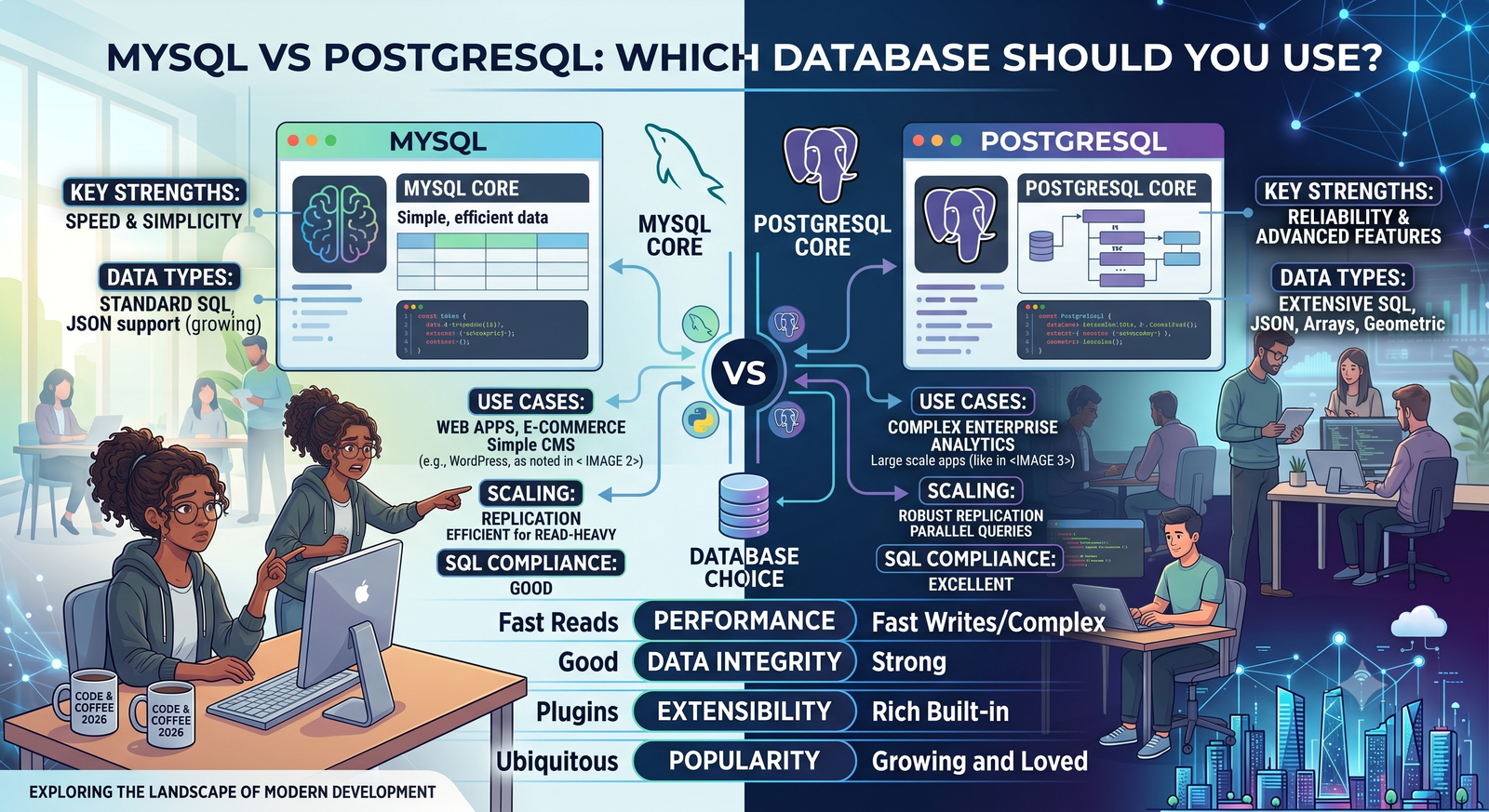
Choosing a database is one of the decisions that can shape an application for years. The database sits behind the scenes, storing users, products, orders, payments, content, transactions, and other information that an application depends on every day.
Two names appear frequently when developers compare relational database systems: MySQL and PostgreSQL.
Both are mature, widely used SQL databases. Both can handle everything from small websites to large applications. Both support transactions, indexing, relationships, constraints, and many of the features developers expect from a modern relational database.
So why is there so much discussion around MySQL vs PostgreSQL?
The answer is that they make different design choices and have different strengths. PostgreSQL is often known for its standards-oriented approach, advanced SQL capabilities, extensibility, and support for complex data models. MySQL is widely known for its simplicity, broad hosting support, strong ecosystem, and popularity in many web applications.
That doesn’t mean one is universally better.
The right database depends on what you’re building, the type of queries your application needs, your team’s experience, operational requirements, and how the system is expected to grow.
Let’s look at the differences in practical terms.
What Are MySQL and PostgreSQL?
Before comparing them, it helps to understand what they have in common.
Both MySQL and PostgreSQL are relational database management systems. They store structured data in tables made up of rows and columns.
For example, an online store might have tables such as:
users
products
orders
order_items
payments
A users table could contain:
| id | name | |
|---|---|---|
| 1 | Alex | alex@example.com |
| 2 | Taylor | taylor@example.com |
The application can use SQL to insert, retrieve, update, and delete this information.
MySQL
MySQL is a popular open-source relational database system. It is commonly used in web applications and is part of the broader ecosystem surrounding technologies such as PHP and many popular content management systems.
MySQL is known for being relatively straightforward to set up and use, while also providing features suitable for large applications.
PostgreSQL
PostgreSQL is an open-source object-relational database system with a strong focus on SQL standards, data integrity, extensibility, and advanced database functionality.
PostgreSQL supports traditional relational data as well as features that make it useful for more complex workloads and data models.
Both are SQL databases, but their capabilities and design philosophies differ in several important ways.
MySQL vs PostgreSQL: Quick Comparison
Here’s a high-level look at the MySQL vs PostgreSQL difference:
| Feature | MySQL | PostgreSQL |
|---|---|---|
| Type | Relational database | Object-relational database |
| SQL support | Strong | Very extensive |
| Ease of getting started | Generally straightforward | Can require more database knowledge |
| Complex queries | Capable | Particularly strong |
| Extensibility | Good | Very strong |
| JSON support | Yes | Yes, with powerful JSON functionality |
| Geographic data | Available through spatial features | Strong spatial ecosystem |
| Full-text search | Supported | Supported |
| Transactions | Supported | Strong transaction support |
| Ecosystem | Very broad | Strong and growing |
| Best fit | Many web and application workloads | Complex, data-intensive, and highly customizable applications |
These categories are only a starting point. Real-world performance and suitability depend heavily on schema design, queries, indexes, hardware, configuration, and workload.
MySQL vs PostgreSQL: The Biggest Difference
One of the biggest differences is their approach to SQL functionality and database extensibility.
MySQL has historically emphasized simplicity and practical performance for common application workloads.
PostgreSQL takes a broader approach and provides a large collection of advanced SQL features, data types, indexing options, extensions, and database-level capabilities.
For a simple CRUD application, you may not notice much difference.
For a system involving complex queries, sophisticated data relationships, custom data types, analytical operations, or advanced database functionality, PostgreSQL can provide more built-in options.
The important question isn’t simply which database has more features. It’s whether those features matter for your application.
SQL Compatibility and Standards
SQL is the standard language used to interact with relational databases, but database systems don’t implement every feature in exactly the same way.
PostgreSQL has a strong reputation for standards-oriented SQL support and provides many advanced SQL features.
For example, PostgreSQL supports capabilities such as:
- Common table expressions
- Window functions
- Recursive queries
- Advanced joins
- Custom data types
- Extensive indexing options
- Powerful aggregation features
- JSON and JSONB operations
- Array types
- Range types
MySQL also supports many modern SQL features, including window functions, common table expressions, JSON functionality, and other advanced capabilities.
This means the gap isn’t simply “basic MySQL versus advanced PostgreSQL.” Modern MySQL is capable as well.
The difference becomes more noticeable when an application relies heavily on advanced database-specific functionality.
MySQL Database: Strengths and Use Cases
MySQL remains a popular choice for web applications and general-purpose database workloads.
One reason is its relatively approachable development experience.
A typical application might have a structure like:
Frontend
   ↓
Backend application
   ↓
MySQL database
The backend uses SQL queries to retrieve and modify application data.
MySQL is particularly common in applications where the data model is fairly conventional and the development team wants a widely supported database with extensive tooling.
Typical use cases include:
- Business websites
- E-commerce applications
- Content-driven websites
- SaaS applications
- Web portals
- Internal business applications
- Customer management systems
- Many PHP-based applications
MySQL also has a large ecosystem of hosting providers, tools, libraries, tutorials, and developers familiar with the platform.
That ecosystem can be an important practical advantage.
PostgreSQL Database: Strengths and Use Cases
PostgreSQL is often selected when developers need more advanced database capabilities or want the database itself to handle more sophisticated data operations.
It supports a broad range of data types and provides powerful features for querying and managing complex information.
PostgreSQL is commonly used for:
- Large web applications
- Data-heavy SaaS platforms
- Financial and business systems
- Analytics applications
- Geographic applications
- Applications with complex relationships
- Systems requiring advanced SQL queries
- Applications that benefit from extensibility
One of PostgreSQL’s strengths is that it doesn’t force every application into the simplest possible relational model.
Developers can use more specialized database features when the application requires them.
Performance: MySQL vs PostgreSQL
Performance is one of the areas where database comparisons often become misleading.
You may see claims that one database is always faster than the other, but real-world database performance doesn’t work that way.
A database’s performance depends on factors such as:
- Query design
- Indexes
- Table structure
- Dataset size
- Hardware
- Memory
- Concurrency
- Transactions
- Configuration
- Application architecture
- Read/write patterns
A poorly designed query can be slow on either database.
Likewise, a well-designed schema and properly indexed query can perform extremely well.
MySQL Performance
MySQL can perform very well for workloads involving frequent reads and conventional application queries.
Applications with straightforward schemas and predictable access patterns can benefit from MySQL’s mature optimization and deployment ecosystem.
PostgreSQL Performance
PostgreSQL can perform particularly well with complex queries, sophisticated joins, analytical operations, and workloads that make use of its advanced query capabilities.
Its optimizer and indexing options provide developers with considerable flexibility.
The practical lesson is simple: don’t choose a database based only on a generic “fastest database” claim.
If performance is critical, benchmark your actual workload.
Concurrency and Transactions
When multiple users interact with a database at the same time, concurrency becomes important.
Imagine an e-commerce application receiving hundreds of orders while customers are browsing products and administrators are updating inventory.
The database needs to handle these operations without corrupting data or producing inconsistent results.
Both MySQL and PostgreSQL support transactions and mechanisms for managing concurrent operations.
PostgreSQL is particularly well known for its sophisticated concurrency model and strong transactional behavior.
MySQL also provides robust transactional support through the InnoDB storage engine, which is the default storage engine in modern MySQL releases.
For many applications, both can handle transactional workloads effectively.
The important question is whether your application has unusual concurrency requirements that make one system’s specific transaction and locking behavior more suitable.
Data Types and Flexibility
One notable PostgreSQL advantage is the range of data types and database features it provides.
Alongside common types such as:
INTEGER
VARCHAR
DATE
BOOLEAN
DECIMAL
PostgreSQL supports additional types and structures such as arrays, ranges, JSONB, UUIDs, and custom types.
For example, a PostgreSQL table can contain an array:
CREATE TABLE products (
    id INTEGER PRIMARY KEY,
    name TEXT,
    tags TEXT[]
);
This can be useful for certain data models.
MySQL also supports a broad range of data types and has strong JSON capabilities.
The key difference is that PostgreSQL tends to provide more options for representing specialized data directly within the database.
JSON Support
Modern applications frequently handle JSON data.
For example:
{
  "name": "Wireless Headphones",
  "features": ["Bluetooth", "Noise cancellation"],
  "rating": 4.5
}
Both MySQL and PostgreSQL support JSON data.
PostgreSQL’s JSONB type is particularly useful when applications need to store and query structured JSON efficiently.
For example, PostgreSQL can query JSONB fields using operators designed specifically for JSON data.
MySQL also provides native JSON support and functions for working with JSON documents.
If your application uses JSON heavily, both databases can work well. PostgreSQL is often attractive when the application requires sophisticated querying of semi-structured data alongside traditional relational data.
Indexing
Indexes help databases find information without scanning every row in a table.
Imagine a customer table containing millions of records.
Without an appropriate index, searching for a particular email address could require examining a large portion of the table.
An index can make that lookup much more efficient.
Both MySQL and PostgreSQL support indexes, but PostgreSQL offers a particularly broad selection of index types and advanced indexing capabilities.
Depending on the workload, developers may use different index strategies for:
- Exact lookups
- Range queries
- Text searches
- JSON data
- Geographic data
- Specialized data structures
MySQL also provides several useful indexing options and performs well when indexes are designed around the application’s actual queries.
Again, indexes aren’t automatically beneficial. Too many indexes can increase storage requirements and make writes more expensive.
Replication and Scaling
Most serious applications eventually need to think about scaling.
Scaling a database can involve:
- Better hardware
- Read replicas
- Replication
- Partitioning
- Caching
- Database sharding
- Query optimization
- Application-level changes
Both MySQL and PostgreSQL support replication and can be used in distributed application architectures.
However, the exact replication features, configuration methods, failover tools, and operational workflows differ.
This is an area where your infrastructure team and hosting environment may influence the choice significantly.
If your company already has established expertise with one database’s replication and backup tooling, that experience can be more valuable than a theoretical feature comparison.
MySQL vs PostgreSQL for Web Development
For web development, both databases are strong choices.
A traditional web application might use:
Frontend
   ↓
Backend framework
   ↓
REST API
   ↓
SQL database
The backend might be built using PHP, Python, Node.js, Java, Ruby, C#, or another language.
MySQL and PostgreSQL can work with all of these ecosystems through appropriate drivers and libraries.
When MySQL Can Be a Practical Choice
MySQL may make sense when:
- Your team already knows MySQL.
- Your hosting environment is optimized around MySQL.
- Your application has a conventional relational schema.
- You need a widely supported database.
- Your development team values a large pool of MySQL experience.
- Your workload doesn’t require specialized PostgreSQL functionality.
When PostgreSQL Can Be a Practical Choice
PostgreSQL may make sense when:
- Your application uses complex SQL queries.
- You need advanced data types.
- You want extensive database extensibility.
- Your system has complicated relationships.
- You need sophisticated JSON querying.
- You expect the database to perform complex data operations.
- Your development team is comfortable with PostgreSQL.
Neither list is exclusive. Both systems can handle a much broader range of applications than these examples suggest.
MySQL vs PostgreSQL for Developers
Developer experience can influence the database decision more than technical comparisons suggest.
If a team has spent years working with MySQL, moving to PostgreSQL introduces a learning curve.
Developers need to understand:
- Different SQL behavior
- Different data types
- Different administration tools
- Different indexing strategies
- Different configuration options
- Different backup and recovery processes
The same is true when moving in the opposite direction.
For a small team, familiarity can therefore be a major factor.
A database that developers understand well may be more useful than one with features the team doesn’t need.
MySQL vs PostgreSQL for Beginners
If you’re learning SQL or building your first application, either database can teach you valuable relational database concepts.
You’ll learn how to:
- Create tables
- Define relationships
- Insert records
- Query data
- Update records
- Delete records
- Create indexes
- Use joins
- Group and aggregate data
- Work with transactions
The fundamentals transfer between database systems.
Once you understand relational database concepts, learning another SQL database becomes significantly easier.
If your course, employer, hosting provider, or project already specifies a database, starting with that system can reduce unnecessary complexity.
Database Management and Administration
Choosing a database isn’t only about writing SQL queries.
Someone also needs to manage:
- Backups
- Monitoring
- Security
- Upgrades
- User permissions
- Performance
- Replication
- Recovery
- Storage
- Availability
Both MySQL and PostgreSQL have mature ecosystems for database management.
The exact tools differ, but modern teams can automate many administrative tasks using cloud platforms, infrastructure tooling, monitoring systems, and database management software.
For managed cloud databases, the provider may handle much of the underlying maintenance.
This can make operational differences less significant than they would be for a team managing its own database servers.
Security Considerations
Security should be part of any database decision.
Both MySQL and PostgreSQL provide mechanisms for:
- User accounts
- Roles and permissions
- Authentication
- Encryption options
- Connection controls
- Auditing and logging capabilities
However, installing a secure database is only the beginning.
Applications should use strong authentication, least-privilege access, secure credentials, encrypted connections where appropriate, input validation, regular updates, backups, and careful access controls.
A secure database architecture depends on how the system is configured and operated, not simply which database product you choose.
MySQL vs PostgreSQL for Large Applications
As applications grow, database requirements often become more complicated.
A small application might need only:
Users
Products
Orders
A larger platform could involve:
Users
Organizations
Subscriptions
Products
Orders
Payments
Inventory
Audit logs
Analytics
Permissions
Notifications
At that point, database design becomes increasingly important.
PostgreSQL’s extensive SQL capabilities and data modeling options can be attractive for applications with complex requirements.
MySQL can also support large and sophisticated applications when its capabilities align with the workload and the system is properly designed.
Scale alone does not automatically determine which database you should choose.
Common MySQL vs PostgreSQL Misconceptions
Database discussions often turn into oversimplified arguments.
“PostgreSQL is always faster.”
Not necessarily.
Performance depends on the workload, query design, indexing, configuration, and hardware.
“MySQL is only for small websites.”
That’s also inaccurate.
MySQL is capable of supporting large production applications.
“PostgreSQL is only for experts.”
PostgreSQL has advanced capabilities, but beginners can use it for straightforward applications as well.
“You can switch databases later without much work.”
Sometimes you can, but migration may involve significant changes.
SQL syntax, data types, indexes, functions, extensions, queries, and application behavior can differ between systems.
Database choice deserves consideration early in a project’s architecture.
How to Choose Between MySQL and PostgreSQL
Instead of asking which database is universally better, ask which one fits your application.
Consider these questions:
What kind of data are you storing?
A straightforward relational model may work well with either system. Specialized or complex data may make PostgreSQL’s additional capabilities attractive.
How complicated are your queries?
If your application depends heavily on advanced SQL, examine the specific features you need.
What does your team already know?
Existing expertise can reduce development and operational costs.
Where will the database run?
Check which systems your cloud provider, hosting company, deployment platform, and infrastructure support.
What are your scaling requirements?
Consider expected traffic, data volume, replication, availability, and growth.
Do you need specific extensions or features?
If your application requires a particular extension, data type, indexing method, or database feature, that can narrow the choice.
How important is portability?
If you expect to move between database systems, minimize unnecessary dependence on database-specific functionality where practical.
MySQL vs PostgreSQL: A Practical Decision Guide
There isn’t a single answer for every project, but a simple decision framework can help.
Choose MySQL when its ecosystem, simplicity, existing team expertise, or application requirements make it a natural fit.
Consider PostgreSQL when advanced SQL capabilities, extensibility, sophisticated data types, or complex data operations are important.
If you’re still uncertain, build a small prototype using your expected schema and representative queries. Test the operations that matter to your application rather than relying solely on general database benchmarks.
This is particularly useful when performance or complex queries are major concerns.
Final Thoughts
The MySQL vs PostgreSQL debate isn’t really about finding one database that wins every category.
Both are mature SQL database systems capable of supporting serious applications.
MySQL can be a practical choice for teams that want a widely supported relational database with a familiar development experience and a strong web ecosystem.
PostgreSQL can be particularly useful for applications that need advanced SQL functionality, sophisticated data modeling, extensive indexing options, or database extensibility.
The best choice depends on your application’s requirements, your team’s skills, infrastructure, expected workload, and long-term plans.
For a simple application, either database may be more than capable. For a complex system, the details of your queries, data model, transactions, and operational requirements matter much more than broad claims about which database is “better.”
The most useful way to approach MySQL vs PostgreSQL is therefore to start with the application—not the database. Define what your system needs to store, how that data will be accessed, how much traffic you expect, and which database features actually matter. Then choose the system that fits those requirements.