
Building a modern website is very different from building a simple collection of HTML pages.
Today’s web applications often need interactive dashboards, real-time updates, complex forms, dynamic navigation, animations, user accounts, shopping carts, and data fetched from backend APIs. Managing all of that with plain JavaScript can become difficult as an application grows.
That is where JavaScript frameworks and related frontend tools come in.
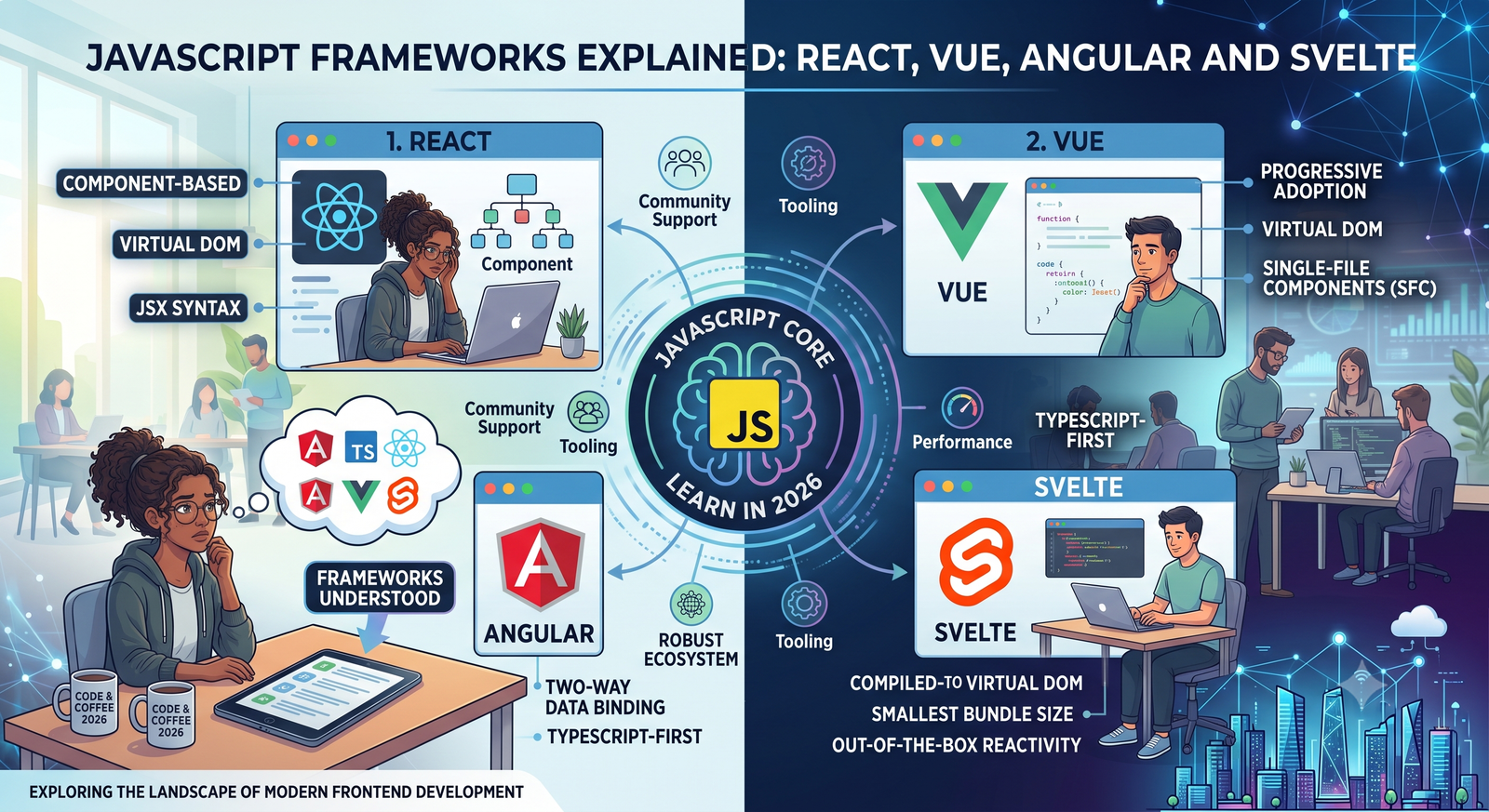
React, Vue, Angular, and Svelte are four of the names developers frequently encounter when choosing a technology for frontend development. They all help developers build interactive user interfaces, but they take noticeably different approaches.
React focuses on a component-based approach and a flexible ecosystem. Vue aims to provide a progressive and approachable development experience. Angular offers a more complete, structured framework with many features built in. Svelte takes a different approach by moving much of the work from the browser into the build process.
So, which one should you use?
There isn’t a single answer that works for every project. The right choice depends on application size, team experience, project requirements, ecosystem needs, and how much structure you want the framework to provide.
Let’s look at the differences in practical terms.
What Are JavaScript Frameworks?
JavaScript frameworks are tools that provide developers with established patterns, features, and abstractions for building web applications.
Instead of writing every part of an application from scratch, developers can use framework features for common tasks such as:
- Creating reusable components
- Managing application state
- Handling user interactions
- Updating the user interface
- Routing between pages or views
- Working with forms
- Communicating with APIs
- Organizing application code
- Managing complex frontend behavior
There is an important terminology distinction worth understanding.
React is often described as a JavaScript library rather than a full framework, while Angular is a full frontend framework. Vue is commonly described as a progressive framework, and Svelte describes itself as a compiler-oriented approach to building user interfaces.
Despite these distinctions, developers often discuss all four together when comparing frontend frameworks.
The practical question is usually the same:
Which technology should I use to build my frontend application?
Why Use a JavaScript Framework?
You can build websites without a framework. Plain JavaScript remains useful and is enough for many projects.
The problem appears when an application becomes more complicated.
Imagine a dashboard with:
Users
  ↓
Dashboard
  ├── Navigation
  ├── Charts
  ├── Notifications
  ├── User settings
  ├── Filters
  └── Data tables
Each part may interact with other parts of the application.
A component-based frontend framework provides a way to divide that interface into manageable pieces.
For example:
Dashboard
├── Header
├── Sidebar
├── UserProfile
├── SalesChart
├── RecentOrders
└── NotificationPanel
Each component can have its own logic, markup, and styling.
This makes large interfaces easier to organize and maintain.
React Explained
React is a JavaScript library for building user interfaces and is one of the most widely used technologies in modern frontend development.
React uses a component-based model.
A component might represent something small:
function Button() {
  return <button>Save</button>;
}
Or something much larger:
function Dashboard() {
  return (
    <main>
      <Header />
      <Sidebar />
      <SalesChart />
    </main>
  );
}
This component-oriented approach allows developers to break complex interfaces into reusable pieces.
React also has a large ecosystem surrounding it. Developers can choose additional libraries and tools for routing, state management, data fetching, testing, styling, and other requirements.
That flexibility is one of React’s major characteristics.
React’s Strengths
React can be attractive when you want:
- A large developer ecosystem
- Reusable components
- Flexible application architecture
- Extensive third-party tooling
- Strong community support
- Many learning resources
- The ability to choose supporting libraries based on project requirements
React’s Trade-Offs
The same flexibility can introduce decisions.
A new React developer may need to choose technologies for:
- Routing
- Data fetching
- State management
- Form handling
- Styling
- Testing
- Application structure
There are many options, which can be helpful for experienced teams but overwhelming for beginners.
React is often a good fit for teams that value flexibility and are comfortable assembling their own frontend stack.
Vue Explained
Vue.js is a progressive JavaScript framework designed for building user interfaces.
Vue also uses components, but it aims to provide an approachable development experience.
A Vue component can combine template, logic, and styling in a single file:
<script setup>
const message = 'Hello';
</script>

<template>
  <h1>{{ message }}</h1>
</template>
Vue can be introduced gradually.
For example, it can be used to add interactivity to part of an existing page rather than requiring an entire application to be rewritten around the framework.
It can also be used to build larger single-page applications.
Vue’s Strengths
Vue is often attractive because it provides:
- A relatively approachable learning experience
- Component-based development
- Clear documentation
- Flexible adoption
- Built-in conventions for common tasks
- A balance between simplicity and capability
Vue can be particularly appealing to developers who want more structure than a collection of individual JavaScript libraries provides without adopting a highly opinionated framework.
Vue’s Trade-Offs
Vue has a strong ecosystem, but its overall ecosystem and industry adoption patterns differ from React’s.
Teams should also consider the availability of developers, existing company experience, project requirements, and the tools they already use.
For many projects, however, Vue offers a comfortable middle ground between simplicity and application-level structure.
Angular Explained
Angular takes a more comprehensive approach.
Unlike React, Angular is a full framework designed to provide many of the pieces required to build large web applications.
Angular applications commonly use TypeScript, which adds static typing and other language features on top of JavaScript.
Angular provides concepts and tools for areas such as:
- Components
- Routing
- Forms
- Dependency injection
- HTTP communication
- Testing
- Application architecture
- Build tooling
This makes Angular more opinionated than React.
That can be useful for large teams where having established conventions is important.
Instead of asking developers to choose among many competing libraries, Angular provides a more integrated approach.
Angular’s Strengths
Angular can be a strong fit when:
- The application is large and complex.
- A structured architecture is important.
- The development team values conventions.
- TypeScript is part of the team’s workflow.
- Built-in framework features are desirable.
- Multiple developers need to follow consistent patterns.
Angular’s Trade-Offs
Angular can have a steeper learning curve than some alternatives.
Developers need to understand several concepts, including components, dependency injection, decorators, services, routing, forms, and RxJS-related patterns.
For a small application, that level of structure may feel unnecessary.
For a large application, however, the same structure can make a complex codebase easier to organize.
Svelte Explained
Svelte takes a different approach from traditional frontend frameworks.
Instead of relying primarily on a runtime framework in the browser, Svelte uses a compiler to transform components into JavaScript during the build process.
A simple Svelte component can look like:
<script>
  let count = 0;
</script>

<button onclick={() => count++}>
  Clicked {count} times
</button>
The syntax is intentionally close to standard HTML, CSS, and JavaScript.
This can make Svelte feel straightforward for developers who already understand the basics of web development.
Svelte’s Strengths
Svelte is attractive because of:
- A relatively simple component syntax
- Compiler-based architecture
- Less framework-specific runtime work in the browser
- Straightforward state handling for many use cases
- A clean development experience
Svelte can be particularly interesting when developers want a modern component framework without the same runtime model used by traditional approaches.
Svelte’s Trade-Offs
The biggest consideration may be ecosystem size and existing organizational experience.
React, Vue, and Angular have large communities and extensive libraries, tutorials, integrations, and established enterprise usage.
Svelte has a growing ecosystem, but teams should evaluate whether the available libraries and developer talent match their project’s needs.
JavaScript Framework Comparison
At a high level, the four technologies take different approaches.
| Technology | General approach | Common strength |
|---|---|---|
| React | UI library with large ecosystem | Flexibility |
| Vue | Progressive frontend framework | Approachability |
| Angular | Full, structured framework | Built-in architecture |
| Svelte | Compiler-based framework | Simplicity and reduced runtime approach |
These descriptions shouldn’t be treated as strict boundaries. All four can be used to build sophisticated applications.
The more useful comparison is how they affect your development workflow.
React vs Vue
The React vs Vue discussion often comes down to flexibility versus integrated conventions.
React gives developers considerable freedom to assemble a frontend stack.
Vue provides a more guided experience while remaining flexible enough for different application sizes.
For example, a React project may require separate decisions around routing and state management, while Vue provides official solutions and conventions for many common application needs.
That doesn’t make Vue automatically better or React automatically better.
A team that values maximum ecosystem choice may appreciate React’s flexibility.
A team that prefers a more guided development experience may find Vue’s conventions easier to work with.
Both use component-based development and can build everything from smaller interactive interfaces to sophisticated web applications.
Angular vs React
The Angular vs React comparison is particularly interesting because they have different philosophies.
React gives you a UI-focused foundation and lets you choose many additional technologies.
Angular provides a much more comprehensive framework.
Imagine two teams building similar enterprise applications.
The React team might choose:
React
+ Router
+ State library
+ Form library
+ Data-fetching library
+ Testing tools
An Angular team can work within a more integrated framework structure.
That can make Angular attractive for organizations that want consistent architecture across large applications.
React may appeal more to teams that want to make architectural decisions themselves.
Again, project requirements and team preferences matter more than a generic winner.
Svelte vs React
Svelte and React both support component-based application development, but they approach rendering differently.
React traditionally relies on a runtime model where React manages updates to the interface.
Svelte moves much of its work into the compilation stage.
For developers, this can result in a different programming experience.
Svelte’s syntax can feel close to traditional HTML, CSS, and JavaScript, while React introduces JSX, where markup-like syntax is written within JavaScript.
Neither approach is inherently appropriate for every application.
The choice can come down to team familiarity, ecosystem requirements, application architecture, and personal development preferences.
Which Framework Is Easiest to Learn?
There is no universal answer because learning difficulty depends on your existing knowledge.
If you already know:
- HTML
- CSS
- JavaScript
- DOM concepts
- HTTP and APIs
then you have a solid foundation for learning any of the four.
Vue and Svelte can feel approachable because their component syntax is relatively close to familiar web technologies.
React introduces concepts such as JSX, components, props, hooks, and state management.
Angular has a larger set of concepts and conventions to learn, particularly for developers who are new to TypeScript and structured application frameworks.
However, the easiest framework to learn is not necessarily the best framework for a particular job.
If you’re joining a company that uses Angular, learning Angular may be more useful than choosing another framework because it appears simpler.
Performance: Does the Framework Matter?
Performance is frequently used as a reason to choose one framework over another, but framework choice is only one part of frontend performance.
A real application’s performance can depend on:
- JavaScript bundle size
- Network conditions
- Image optimization
- Server response time
- Rendering strategy
- API performance
- Caching
- Code splitting
- Third-party scripts
- Application architecture
- How efficiently the application is implemented
A poorly designed React application can be slow.
A well-designed React application can be fast.
The same principle applies to Vue, Angular, and Svelte.
Framework benchmarks can be useful for understanding technical characteristics, but they don’t automatically predict how your specific application will perform.
For production projects, test the actual application and measure real user-facing performance.
Ecosystem and Community
The ecosystem surrounding a frontend technology can matter almost as much as the technology itself.
A mature ecosystem gives developers access to:
- Libraries
- Components
- Development tools
- Documentation
- Tutorials
- Testing solutions
- Hiring resources
- Community discussions
- Third-party integrations
React has an especially large ecosystem.
Angular has strong adoption in enterprise-oriented environments and a comprehensive official framework structure.
Vue has a mature ecosystem and is widely used for web applications.
Svelte has a smaller ecosystem but provides an increasingly capable development environment.
Before choosing a framework, check whether the libraries you actually need exist and are actively maintained.
TypeScript and JavaScript Frameworks
TypeScript has become an important part of modern frontend development.
It adds static typing to JavaScript and can make large codebases easier to reason about.
Angular is closely associated with TypeScript and uses it extensively.
React and Vue can also be developed with TypeScript.
Svelte supports TypeScript as well.
For larger teams, types can help catch certain mistakes during development and make APIs between components easier to understand.
However, TypeScript adds its own concepts and tooling, so beginners don’t necessarily need to learn every TypeScript feature before building their first frontend application.
Server-Side Rendering and Modern Web Applications
Modern frontend development isn’t limited to applications that run entirely in the browser.
Many projects use rendering strategies such as:
- Client-side rendering
- Server-side rendering
- Static generation
- Hybrid rendering
React can be used with frameworks such as Next.js.
Vue has frameworks such as Nuxt.
Angular provides server-side rendering capabilities through its broader application platform.
Svelte has SvelteKit for building complete web applications.
This is an important distinction.
Choosing React, Vue, Angular, or Svelte may be only the first decision. You may then choose a larger application framework or platform around it.
When Should You Choose React?
React can make sense when:
- You want access to a very large ecosystem.
- Your team already knows React.
- You want flexibility in architecture.
- You’re building a complex interactive application.
- You need a wide range of third-party integrations.
- Hiring React developers is important to your organization.
Its flexibility is one of its defining characteristics.
That flexibility also means your team needs to establish good conventions so that the codebase doesn’t become inconsistent.
When Should You Choose Vue?
Vue can be a good fit when:
- You want a relatively approachable framework.
- You prefer component-based development.
- You want to adopt a framework gradually.
- Your team values clear conventions.
- You need a framework that can scale from smaller interfaces to larger applications.
Vue is often attractive when developers want a balance between simplicity and application-level capabilities.
When Should You Choose Angular?
Angular can be appropriate when:
- You’re building a large application.
- Strong conventions are valuable.
- Your team is comfortable with TypeScript.
- You want many framework capabilities provided together.
- Long-term maintainability and consistent architecture are major concerns.
Angular’s comprehensive nature can be an advantage for teams that don’t want to assemble a frontend stack from numerous independent libraries.
When Should You Choose Svelte?
Svelte can be worth considering when:
- You like a simpler component syntax.
- You want a compiler-based approach.
- Your team is comfortable with modern JavaScript.
- The available ecosystem meets your requirements.
- You want to explore an alternative to more established frontend frameworks.
Svelte can be especially interesting for developers who want an approach that feels close to writing standard web components while still providing application-level capabilities.
Common Mistakes When Choosing a Framework
Framework selection can become unnecessarily complicated.
One common mistake is choosing a technology because it is currently popular without considering the project.
Another is focusing exclusively on benchmark results.
Other common mistakes include:
- Ignoring team experience
- Choosing a framework without checking required libraries
- Underestimating maintenance needs
- Ignoring hiring considerations
- Switching frameworks too frequently
- Selecting a complex stack for a simple project
- Assuming the framework will solve architectural problems automatically
A framework is a tool. It doesn’t replace good application design.
What Are the Best JavaScript Frameworks?
The phrase best JavaScript frameworks can be misleading.
There isn’t one framework that is objectively best for every application.
Instead, think in terms of fit.
React may fit a project that values flexibility and ecosystem size.
Vue may fit a team looking for an approachable and progressive framework.
Angular may fit a large application that benefits from a comprehensive and structured platform.
Svelte may fit a project where its compiler-based approach and development experience match the team’s needs.
The “best” choice changes with the problem you’re solving.
A Simple Framework Selection Checklist
Before making your decision, ask:
1. What are you building?
A small interactive website has different requirements from a large enterprise application.
2. Who will maintain it?
The team’s existing knowledge should influence the decision.
3. Which libraries do you need?
Check routing, forms, charts, authentication, data fetching, testing, and UI components before committing.
4. How much structure do you want?
Angular provides more structure out of the box. React gives teams more freedom. Vue and Svelte sit differently on that spectrum.
5. What are your long-term requirements?
Consider expected growth, hiring, maintenance, documentation, and ecosystem maturity.
6. What does your hosting and deployment environment support?
The framework itself is only one part of the application’s infrastructure.
Final Thoughts
Modern JavaScript frameworks make it easier to build interfaces that would be difficult to manage with plain JavaScript alone.
React, Vue, Angular, and Svelte all solve similar problems, but they approach those problems differently.
React emphasizes components and flexibility. Vue combines an approachable development experience with a progressive framework model. Angular provides a comprehensive and structured environment for building applications. Svelte takes a compiler-based approach that shifts much of the framework work into the build process.
The differences matter, but they shouldn’t turn framework selection into a popularity contest.
If you’re starting a new project, look at the application’s requirements first. Consider the team’s experience, the ecosystem you need, the amount of structure you want, and how the application is likely to evolve.
For developers learning frontend development, there’s also no need to treat your first framework as a permanent commitment. The concepts you learn—components, state, routing, API communication, rendering, accessibility, performance, and application architecture—transfer between many modern frontend technologies.
Once those fundamentals are clear, learning another framework becomes much easier.
The most useful JavaScript framework comparison is therefore not simply React vs Vue, Angular vs React, or Svelte vs everything else. It’s a comparison between your project’s actual needs and what each technology provides.
Choose the tool that fits the work, build with good engineering practices, and focus on creating an application that remains understandable and maintainab